

Synthesizability Game
A high-entropy ceramic for nuclear waste can contain several elements on each of two cation sites. Some compositions are synthesizable; others are not. Your goal is to find one that is.
- Choose the A or B site, then select elements from the periodic table. You can also drag elements directly onto a site.
- Press Check to calculate the synthesizability score, from 0 to 100.
- A score of 50 or higher is classified as synthesizable. If the score is below 50, change the elements and try again.
A site
Tap elements to add them here.
B site
Tap elements to add them here.
Swipe sideways to see the whole table.
- Alkali metals
- Alkaline earth metals
- Transition metals
- Post-transition metals
- Metalloids
- Nonmetals
- Noble gases
- Lanthanides
- Circle size: relative ionic radius
Press Check to see the score.
For educational purposes only.
About the game
We presented this game at the 2026 ARPA-E Energy Innovation Summit in San Diego.
This game is for educational purposes only. Every element carries a weight for the A site and a weight for the B site. We set those weights by hand for the demonstration, from chemical judgment about which elements suit which site, and they combine into one score between 0 and 100. A research question about a specific composition needs first-principles calculations for that composition, followed by synthesis and testing.
Each Check is recorded with the elements on each site, the score, and your address and browser. On s4e.ai, your account is recorded too when you are signed in.
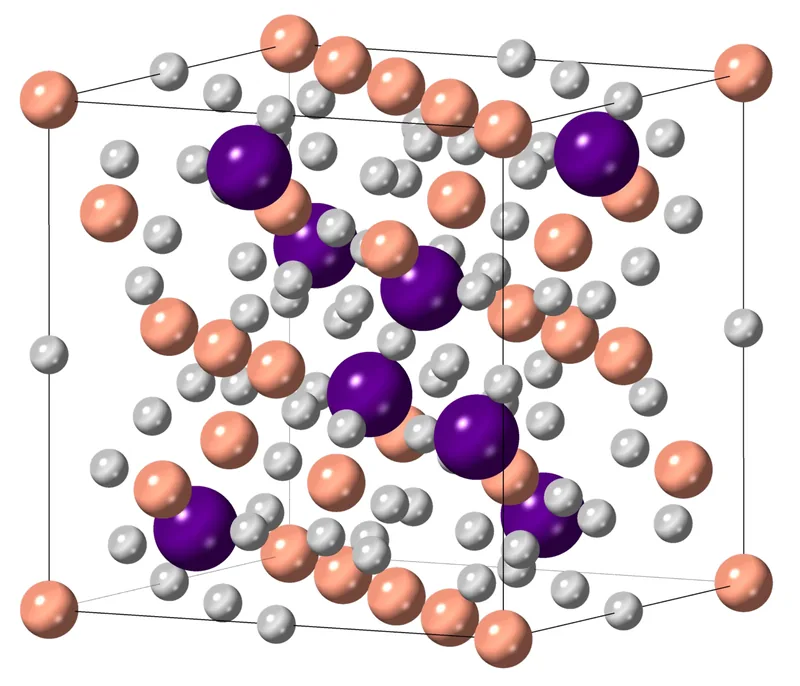
The research behind the game is published in Xu et al., Stabilizing iodine in pyrochlore: toward new nuclear waste forms, Precis. Chem. 4, 1211 (2026), and described on the Research page.